There Is No Safe Level of Myopia
A Conversation with Dr. Patrick Simard on Myopia Management, Specialty Care, and Independent Optometry
Myopia is no longer just a refractive error—it’s one of the most significant public health challenges facing eye care today. In this episode of The 20/20 Podcast, Dr. Harbir Sian sits down with internationally respected myopia management expert Dr. Patrick Simard to explore why early intervention matters, how optometrists can build sustainable specialty practices, and what the future of myopia control looks like.
Recorded live at the OSI National Summit in Niagara-on-the-Lake, this conversation blends clinical insight, business strategy, and real-world experience, making it essential listening—and reading—for optometrists at every stage of their careers.
Watch The Episode Here
Why “No Safe Level of Myopia” Changes Everything
One of the most powerful messages from this episode is simple but profound: there is no safe level of myopia.
Dr. Simard explains that even low levels of myopia in young children significantly increase the risk of future ocular disease, including retinal detachment, glaucoma, and myopic maculopathy. A nine-year-old child presenting with -1.00D of myopia is not “mild”—it’s a warning sign that demands action.
This shift in thinking reframes myopia as a progressive disease, not just something to correct with glasses. It also underscores why optometrists must intervene earlier than ever before.
From Primary Care to Specialty Practice: A Smarter Career Path
Beyond myopia management, this episode dives deep into career development and practice ownership. Dr. Simard shares his journey from associate to partner, and eventually to full-time specialty care focused on myopia management and specialty contact lenses.
Key takeaways include:
- Why ambition and initiative matter more than seniority
- How associates can create value and influence ownership decisions
- Why giving up a percentage of ownership can actually grow the overall “pie”
- How long-term succession planning preserves independent optometry
Rather than viewing ownership as an all-or-nothing decision, Dr. Simard highlights partnership as a powerful tool for growth, mentorship, and continuity.
Getting Started in Myopia Management (Without Feeling Overwhelmed)
A common barrier for optometrists is the belief that they must master every myopia control modality before starting. Dr. Simard strongly disagrees.
You don’t need to offer everything on day one.
Whether it’s low-dose atropine, myopia control spectacles, soft contact lenses, or orthokeratology, the key is to start with one tool, gain confidence, and expand gradually. Waiting for perfect knowledge only delays care for children who need help now.
Pre-Myopia: The Next Frontier in Eye Care
One of the most forward-looking parts of the discussion focuses on pre-myopia—children who have not yet become myopic but are rapidly losing their hyperopic reserve.
Emerging research suggests that early intervention, including optical strategies and atropine, may delay the onset of myopia altogether. Dr. Simard discusses how this preventive approach could reshape pediatric eye care over the next decade.
This represents a major opportunity for optometrists to move further upstream—treating risk before disease progression begins.
Collaboration Over Competition in Specialty Optometry
As optometrists move into specialty care, concerns about competition often arise. Dr. Simard offers a refreshing perspective: specialists don’t compete—they collaborate.
By clearly defining referral criteria, educating colleagues, and providing detailed reports, specialty optometrists can strengthen professional relationships while elevating the standard of care across their communities.
The result? Better patient outcomes, stronger referral networks, and a larger overall patient base for everyone.
5 Key Learning Points from the Episode
- There is no safe level of myopia—early intervention is essential
- You don’t need to master every tool to start myopia management
- Entrepreneurial mindset is critical for ownership and growth
- Pre-myopia treatment represents the future of preventive eye care
- Independence in optometry requires intentional long-term planning
5 Standout Quotes from Dr. Patrick Simard
“There is no safe level of myopia. A nine-year-old at minus one is not normal.”
“You don’t need to master the entire toolbox—just start with the one you feel comfortable with.”
“Giving up a piece of the pie doesn’t mean making less money. A bigger pie benefits everyone.”
“Specialists don’t compete—they collaborate.”
“If you hesitate to start myopia management, now is the right time to jump in.”
About Dr. Patrick Simard
Dr. Patrick Simard, OD, MSc, MBA, FAAO, is a recognized leader in myopia management and specialty contact lenses. He is a graduate of the Université de Montréal, where he also earned a Master’s degree in Vision Science, and later completed an MBA at HEC Montréal. He is a clinical instructor and lecturer, co-owner of Clinique d’Optométrie Bélanger, and a co-holder of a patent for a contact lens design aimed at controlling myopia and axial elongation.
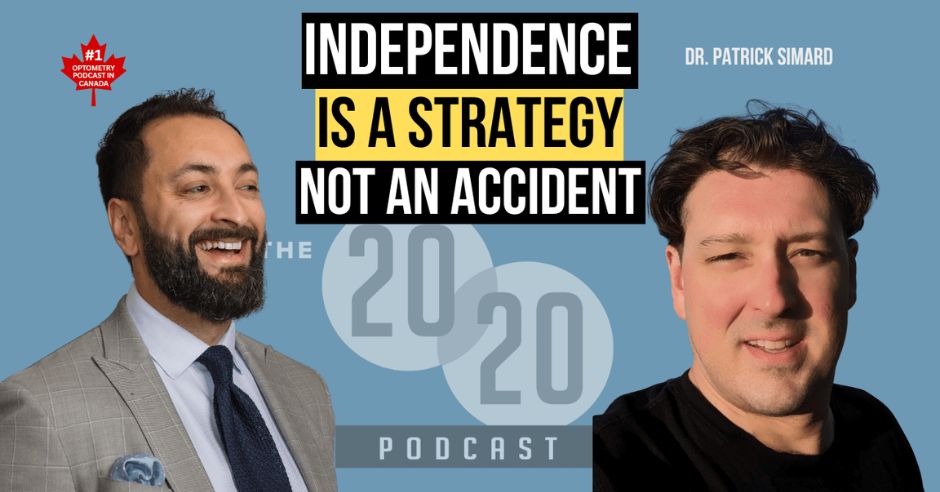
Independence is a Strategy not an Accident – Full Episode Transcript
Guest: Dr. Patrick Simard, OD, MSc, MBA, FAAO
Host: Dr. Harbir Sian
Note: This transcript has been lightly edited for clarity, grammar, and readability. No content has been removed or summarized. Speaker intent and meaning are fully preserved.
Dr. Harbir Sian:
Hello, and welcome back to another episode of the 2020 Podcast, Canada’s #1 Optometry Podcast. I am your host, Dr. Harbir Sian. Thank you so much as always for taking the time to join me, guys. I am so grateful for all the support. And as always, I have a big request right off the top, and that is if you get any value from this conversation, please do share it. Put up a link on LinkedIn, put a screenshot up on Instagram, whatever, Facebook, wherever you like to spend your time online, tell a friend, send a text message. let them know that we’re having these conversations that are, I think, going to be very helpful and valuable and impactful for all of our colleagues and for the profession as a whole. Before we jump in and before I introduce my amazing guest here, I want to say a big thank you to OSI. We are at the OSI National Summit here at the White Oaks Resort in Niagara-on-the-Lake. So I want to say a big thanks to OSI for giving us the space. Also a big shout out to our video production team, LCA Productions, amazing team. with this beautiful setup. Every time we work together, they make it look impeccable. So I’m always grateful to work with them. And now, an amazing thank you to our wonderful guest, Dr. Patrick Simard, who is an amazing myopia management guru. I am excited to have him on. He literally, you know, it’s one thing to say, we were joking about this earlier, it’s one thing to say somebody is an expert. I can go on next level and say, somebody’s a guru in this space. It’s a rare error when I get to say somebody actually wrote the book on myopia management or whatever specialty we’re talking about. So Dr. Simard has written a book on myopia management, “One child at a time”.
Dr. Patrick Simard:
Exactly.
Dr. Harbir Sian:
That’s correct. I didn’t have it in front of me, but I’m glad I remembered. Great book, you know, and really helpful for me as I was getting into my myopia journey. But a little bit more about Dr. Samar, graduate from the Montreal, University of Montreal in 2002. He’s a clinical instructor and lecturer still there. He is a partner at, now I’m going to butcher this, but I’m going to try, Clinic D’optometry Belanger. Well done, good job. Okay, but we’re going to talk about a bunch of different things. I’d like to quickly tease off the top, but we’re going to talk about getting into business ownership, partner, different types of partnership, and Patrick’s going to talk about his journey into that. We’re going to talk about the journey from primary care into specialty care, and then we’re going to dive a little deep into myopia management since that is a specialty. what’s hot and new in myopia management as well. So thank you, Dr. Samar, for being here.
Dr. Patrick Simard:
Thank you for having me.
Dr. Harbir Sian:
My pleasure. And I know this is a very big, long introduction, but anything you’d like to share that I didn’t mention about you, about your career right now?
Dr. Patrick Simard:
Fair enough. I’m still wear many hats.
Dr. Harbir Sian:
Yes.
Dr. Patrick Simard:
So you resume quite what’s important for the talk today.
Dr. Harbir Sian:
Fair enough. You do wear many hats, and as I mentioned off the top, we’re going to touch on a couple of them, right? So I want to say we’re going to, the arc of the conversation is from early in your career as primary care practitioner into super specialty care. But a big part of that is going from an associate to an owner. So maybe let’s start with that. What was your journey from associate to ownership?
Dr. Patrick Simard:
I was lucky enough at the beginning of my career to end up with a private group practice, at the time an OSI member. And I started with primary care. So the full scope optometry as we speak of. And I’m old, but not that old enough that one year into practice, we got TPAs in Quebec. So I was fortunate enough to basically start my career with that opportunity up front. So my goal over time, that’s why I started a research master degree on keratoconus, was to move from primary care to specialty contact lens practice. So very early on, I was approached by my partner at the time to be part of the group and become a co-owner with them. I thanked them. It was a huge opportunity. And it allowed me early on in my career to choose a path and to be involved in the process of designing my clinical environment.
Dr. Harbir Sian:
Right. So when you become a partner now, you’re obviously invested literally financially invested, but also emotionally now invested in this business. And you want to cultivate the type of practice that you want to work in, right? So that’s an interesting opportunity to come in early as a business owner, as a business partner. What was the decision-making process? Was it an easy, like, hell yes, I want to do this? Or did you have to think through what your journey would be?
Dr. Patrick Simard:
It was quite an easy process to go into ownership. In fact, I was looking to practice in that type of environment right from the start. And I add that attitude, entrepreneur attitude, that you want to create something and to look beyond only patient care.
Dr. Harbir Sian:
Yeah, that’s actually very interesting. Something I wanted to ask you related to this, and you touched on it already. I want to look at this from both sides, owner side and associate side. So from an owner side, you’re already talking about it, but what should an owner look for as in somebody that is an associate and they maybe are thinking about bringing them on as a partner? One is this sort of entrepreneurial mindset.
Dr. Patrick Simard:
Ambition. If you find someone really ambitious, they want to get involved early on matters that are not supposed to be managed by those associates. I remember at the time I wanted to get involved into the prices, even though I was not a co-owner. I managed to convince the owner to buy a topographer at the time, even though I wasn’t an owner yet. And they agreed because I came up with a business plan to start to do orthokeratology early on at the beginning. At the time, we were talking about early 2000, It was not trendy to do our talk on kids. It was quite a challenge.
Dr. Harbir Sian:
I see.
Dr. Patrick Simard:
But we jump in, and from that, I started my Myokia management journey with that first device. Doesn’t take a lot of device to get going. I’ll say a topographer, it’s a nice start, and then you can start building skills over time.
Dr. Harbir Sian:
Absolutely, absolutely. I think you need some sort of investment to really lean into the specialty, but I do like to say to our friends out there, colleagues out there who are thinking about getting into myopia management or would like to get into it, you don’t need that machine right now to get started. Don’t let that be your obstacle to start, but definitely keep it in mind that you should invest in that soon. And topographer is one piece that’s been really useful for us too. So we talked about, that’s really helpful, you know, from a business perspective, business owner’s perspective, I should be looking for somebody who takes initiative, who’s ambitious, who’s asking questions. And I think, now let’s flip it from the associate side of things. What should associates be looking for in a practice that they want to partner in? Before you answer, I want to say one quick thing is I think associates should understand they have more power than I think they realize. You convince the owner to buy a topographer. As a business owner myself, if an associate is ambitious and takes initiative and comes to me and says, Harbir, we could do more business or I think I could build this side of your business, I would be very interested in that conversation. Not like a little bit, like let me take you to dinner and let’s sit down and talk about this. So I think associates should understand that they have that power if they are that kind of go-getter type of person. So tell me from your perspective, you were that associate who bought into this practice. What were you looking for in the business?
Dr. Patrick Simard:
I was really looking forward to help growing the practice. And we did. We managed over 15 years three renovation of the clinic. So we passed from a tree lane clinic to a nine lane clinic.
Dr. Harbir Sian:
Wow.
Dr. Patrick Simard:
Double 2 times over that span in term of clinic. It is impressive and it shows a different path for an owner that owned a complete amount of the clinic that there’s a way to keep independent optometry alive by letting some peace over time to new blood. And the new blood will help shape the direction and the success of the clinic.
Dr. Harbir Sian:
You know, I think one of the things that owners are afraid of is if I give up part of my business, a percentage, I’m going to make less money. But also giving up control, they’re afraid that they won’t have a say or control the way the business is run. But I think you’re saying that a bigger pie actually is better.
Dr. Patrick Simard:
Exactly. And I’ve lived through that aspect of it, where over time, we grow so much that the pieces given by the initial owner was lower than the increase in the amount of the.
Dr. Harbir Sian:
They ended up actually making more money in the long run.
Dr. Patrick Simard:
Much more, much more. Even though they had. And that owner already has his buyer for the retirement.
Dr. Harbir Sian:
So that is an important.
Dr. Patrick Simard:
A huge aspect of it. So retirement can be planned 10, 15, 20 years ahead. And right now, I’m in the process at identifying who’s going to buy my share in 20 years. And the good thing is there is still some people that want to get involved. Some of the thrive on that, they’re looking for that, and they want to be corner of their working place.
Dr. Harbir Sian:
That’s actually a really, really important point because I think there’s a lot of people, a lot of our friends and colleagues out there are weary of this, of the fact that there’s private equity and big buying groups and things or groups that are rolling up practices and that. And perhaps they don’t want to go that route, but then they don’t know how to avoid that. How do I keep my business private, my practice private and independent? And I think what you said is so important. Start thinking about it really early. And by letting other ODs come in and buy shares or a percentage of your business, you’re giving yourself a good exit plan 20 years down the road. That’s a really, really good point. And one thing we were talking about earlier, I just want to quickly share this, I think is important. One of the questions that owners might ask is, well, how do I find these associates? You know, perhaps you have those associates in your practice now and you need to groom them. But I was mentioning to somebody else just recently that We have to think about, we market to our patients. Imagine we’re marketing a specialty. We’re talking about myopia management. We can look at what is our current patient base? What patients do I have right now who could benefit from this? But then now I have to do external marketing to bring some of those patients in so I can grow this specialty. We should think about that recruiting ODs the same way, or even staff the same way. You know, how am I, what does my website say about my business? And is it going to attract the type of OD that I want working in my practice. What does my social media say about my business? Is it going to attract that? And I think that’s something that’s going to become more relevant now with the younger generation of ODs. They’re going to look at scout, they’re going to scout these offices and businesses and to see if they align with their values and what they want. So I think that’s something that we should be thinking about. Again, we’re thinking 20 years down the road when I’m going to retire, I’m going to structure my website. So I’m attracting those ODs. So 20 years later, I have an exit plan, right? So there’s different ways to, layers to this plan of ours. Okay, so we talked about you getting into ownership. Let’s talk about your journey from primary care to specialty care, because you said buying into the practice was an important step.
Dr. Patrick Simard:
So over time, the clinic grew, and I was able to allocate more and more time to the specialty, whether it is scar lenses, specialty contact lens, or myopia management. And right before COVID in 2019, I fully committed to allow all of my time to specialty contact lens.
Dr. Harbir Sian:
So it took some time, I mean, for you to, that’s we’re talking a 12 year timeline from primary care to slowly more specialty to now ultimately only specialty care.
Dr. Patrick Simard:
Exactly. And now five to six years after, I must admit, for me, it was quite the right choice. At the beginning, I had the fear of missing part of the optometry scope. I’m really grateful to the team of OD I’m working with. because they can manage other aspects of optometry that are also quite important while I focus on what makes me more passionate about my work.
Dr. Harbir Sian:
I think that’s actually an important, very important part to talk about as well, right? You built this over time, but within your practice, you have other ODs that you can refer to for other specialty care. whether it’s dry eye or VT or whatever, primary care even.
Dr. Patrick Simard:
We are a team and each of these kind of have their specific identity and their clinical space to operate within that. That’s part of our success.
Dr. Harbir Sian:
What advice would you give to somebody? I know, of course, you’re in myopia management, specialty contact lens, but I think there’s so much overlap in as far as like the strategy to become a more specialty care doctor. What advice would you give somebody, whether they’re in dry eye or some specialty contact lens or myopia, and they say, well, I’m mostly seeing primary care. Let’s say I’m 80%, 85% primary care, 15, 20% specialty care. What steps do you think they should take step one, two, three, to kind of lean in that more specialty direction.
Dr. Patrick Simard:
I think the first step will be to identify the right balance you want to have. It’s okay to only do 20% specialty care and take care of the rest of your population. But if you want to increase that specialty aspect of your practice, you need to seek for knowledge. And The first thing you don’t need a residency to start to be a specialist.
Dr. Harbir Sian:
That’s a very, I appreciate you bringing that up.
Dr. Patrick Simard:
Knowledge is up there. Everyone can access them. The only thing you need is the proper patient base and clientele, and this is what you need to build over time. So the first step will be to commit time to train yourself. There is some specialty meetings around the subject you want to do. Really important to create your network of ODs, already specialists in that area you want to focus on. Those kind of guys just want to share their knowledge, just want to share their path, their walkthrough.
Dr. Harbir Sian:
Yeah, that’s so true, actually. I think we worry sometimes that our colleagues, maybe there’s a concern about competition. But when you, the more you specialize, this is, I’ve learned this lesson myself now, you know, through meeting amazing people like yourself and David Ng, we were just chatting earlier, and Sherman Tong in Vancouver. As I lean more and more into myopia management, and into ortho K and this kind of thing. The people who specialize, they love, they’re so passionate about what they do. They just want to share. They just want to share. There’s no aspect of competition. Even if, like, for example, Sherman, he’s a 30 minute drive, 40 minute drive from my office. It’s not that close, but it’s close enough that people will drive for specialty care. But when I ask him, I used to refer patients to him, and now instead I said, Sherman, I’m going to keep these patients now. And he was like, please. take them. And not only exactly, he’s like, there’s too many patients for me to see by myself. That’s one thing. But not only that, anytime I text or call him, here’s the answer to your question. Here’s how I do my structure, my fees, or here’s how I address this issue. And I feel that really from everybody I speak to in the space. I would encourage, again, whether you’re dry eye or VT or whatever, the more niche you get, the more you’re going to find your tribe. And when you find that tribe, they’re going to really support you.
Dr. Patrick Simard:
Yeah. And if we go back to how you build your specialty, the next step will be to build your referring network.
Dr. Harbir Sian:
Oh, yeah.
Dr. Patrick Simard:
And the referring network can be within your group practice. So you want to make sure to clarify what kind of patient you want to see. Criteria list. So you send me that patient at that moment clinically, this is where I want to see it. And you’ll see it back at the end when I’m done with my specialty work. This is inside your clinic and you also need to do it outside your clinic.
Dr. Harbir Sian:
Right. So I wanted to ask you about that. So when you’re developing your referral network, other ODs, maybe GPs, are you talking, if we’re talking myopia management, are we talking pediatricians? What type of doctors or referral network are you developing?
Dr. Patrick Simard:
Every network. And sometimes it’s always a word of mouth, usually, right patients. Some patients are very vocal about their experience, and they talk a lot about it to the pediatrician or their family. So every referring patient by word of mouth.
Dr. Harbir Sian:
It’s so valuable, that word of mouth referral. I wonder if you’re, let’s say we’re talking about connecting or creating that referral network with other ODs in the area, right? Not within your practice. ODs, you say, listen, I do myopia management or I do ortho K. If you don’t do it, you know, when you have a patient, please send it to me. Do you go about, how do you go about, is it just a phone call? Is it an e-mail or do you go in person and talk to them? How do you usually, what would you suggest?
Dr. Patrick Simard:
In my case, I was lucky enough to teach at the school.
Dr. Harbir Sian:
Oh, right.
Dr. Patrick Simard:
So basically right from the start, I had a touch base with those future ODs.
Dr. Harbir Sian:
Yeah. That’s a huge advantage.
Dr. Patrick Simard:
That gives you a lot of notoriety. My advice would be really to make sure you clarify what type of patient you want. An example, 10 years old and younger, progressing at a very fast pace, those are ideal candidates for orthokeratology. So if you have someone who’s doing myopia control with soft contact lens, multifocal, antimyopic glasses, atropine, but don’t want to jump in right now into ortho-caratology, that’s where you can be a valuable referral center for that place and only take care of that dose patient. For them, they don’t see that type of patient every day. It might be once every two, three weeks. But for you, you’ll get many referrals from different sources and you’ll be able to specialize over that kind of patient.
Dr. Harbir Sian:
Got it. And so when as you, that referral network, as they start sending you more patients, then you can start to change your patient base and how many specialty care patients you’re seeing versus primary care as more of those referrals will come in. I want to, if it’s okay.
Dr. Patrick Simard:
And report. good. Yes. Sending back a report. This is where you can show appreciation for the referral and also improve their clinical skill by putting some teaching stuff into the report. So they build also their confidence over myopial control.
Dr. Harbir Sian:
The other doctor that you send. The other doctor, because it’s such a…
Dr. Patrick Simard:
It’s all about education, you know.
Dr. Harbir Sian:
And that’s actually really valuable because we are supporting our colleague who sent us a referral first. Like you said, appreciation is the number one. Thank you so much for the referral, but also helping them kind of come up to a little bit more up to speed. Perhaps they are going to, maybe they start seeing more myopia control themselves. That’s fine. Again, that’s better, bigger pie for all of us. But maybe they start to see more patients that could be referred to you. Like they start to realize that there are more patients they could send to you based on what you’ve sent back to them. I want to say one key thing. There’s actually two things I just want to expand on very quickly on that. This really, really all very useful information. So on the note of the, I want to talk about the report in a moment. But first, as far as building your referral network, if there’s any ODs who are listening who are thinking they want to reach out to colleagues and, you know, start to get more referrals, whether it’s for dry eye or for myopia or for whatever it is, One thing that I did is I went, I sent my staff to make the initial point of contact, but then we followed up. But I created a little pamphlet or a brochure in Canva. And I’ve done this before on the podcast because I create templates for different things. So if there’s somebody out there who wants to see what I created as far as a brochure, just e-mail me info at the2020podcast.com or you can message me on Instagram and I’m happy to share it with you. But basically, I created this little brochure, and it says, here’s what we do in our office. We want to collaborate with our colleagues. And we are only going to see them for this, and we’re going to send them right back to you, kind of reassure our colleague about that. And talk a little bit about the technology that we have for dry eye. We have the radio frequency, the IPL, or if we’re doing myopia management. We do ortho K, we use this topographer. But to your point, then also, specify a little bit what type of patient we would see. we don’t want to see all your myopia patients. Let’s just see the ortho K patients, right? And here’s a topographer we use and here’s the lens we use. So if anybody’s interested in that, I’m happy to share that with you. But so I had my staff go, they took some cupcakes or something, and then they went to the, and they said, here’s the pamphlet. And then we got a little bit of engagement from some of the doctors that way. So that was one step that we took with ODs in our area. So I don’t know if you have any thoughts on that.
Dr. Patrick Simard:
That’s a great way. Okay. I want to talk.
Dr. Harbir Sian:
About the report really, really quickly. One of the things… That is such a burden for many of us is like writing referral letters and writing reports after. Your EMR can help you so much in this if you have templates for everything. If you have created a good template, so we have a template for a report that I’m going to send for myopia. Click that, it’s linked to the patient, it already draws the information out from the patient, refraction, axial length, all the other things. And then I just type a, thank you, here’s what I saw, here’s what we did. And so just a quick shout out, we use Opticys. as our EMR. So if you’re using something that doesn’t let you do that, I would highly recommend you look into this program. I think it would be very, very helpful for you.
Dr. Patrick Simard:
I totally agree. And don’t get me started on Optosys. I’m a huge fan and I’m a long time advocate of that EMR.
Dr. Harbir Sian:
I knew it. I knew it. We could have a whole podcast series on Optosys and the functionalities and all the things, not even just one big podcast, multiple. And for those who do use OptiSys, this because there’s webinars happening. Like every few months, there’s a webinar on this feature or that feature. So we’re still, we only use a fraction of what its capability is. But when we switched a couple of years ago, we found it hugely, hugely beneficial to our practice. So anyway, we can go on that tangent all day long. So let’s talk about myopia management a little more detailed. You are the guy who wrote the book on myopia management. What, okay, let’s talk about from entry level or lower, for our friends and colleagues who are beginner level, what advice would you have, one or two pieces of key advice? And then we’re going to go super advanced level, what’s like really new and happening. So let’s go entry level for our colleagues first.
Dr. Patrick Simard:
First of all, it’s a great time to start Myocia Management. And Canada is a great place to start myocal management because we are one of the first markets for almost every technology in the world. Very interesting. Because we have a diverse patient base and a lot of proactive doctors. Being very proactive in that, what I think should be the first thing in mind is to make sure we understand properly that there is no safe level of myopia. And we need to treat myopia much earlier than we thought. So being a -1 and being nine years old, it’s not normal. And we know that the kids will progress more and more. And we know that we are even moving towards more preventive care. And we now have scientific evidence that we can even act earlier than that. We can act in the pre-myopia stage. So when we get a patient losing that hyperopic reserve for the age, this is a sign that the patient will become myopic. And we have data showing that atropine is effective in those kind of situation to delay myopia apparition. And also there is now some data that will come in the next couple, next year on the effectiveness of antimyopic glasses on those pre-myopic patients where you only wear the glasses 3, 4 hours a day.
Dr. Harbir Sian:
Interesting, interesting.
Dr. Patrick Simard:
And you can delay myopia by 50%.
Dr. Harbir Sian:
50%, wow.
Dr. Patrick Simard:
So this is huge.
Dr. Harbir Sian:
That is huge. Okay, so that’s a really important topic that I like to talk about as well. So for those of our colleagues who are a little earlier stages of myopia management or just starting to get comfortable with it, I think the concept of treating pre-myopic kids makes them a little uncomfortable, and especially with a pharmaceutical agent. Now, I can say I do have a couple of patients who are, six years old and plus 1/4 when they should be, they should have significantly more hyperopic reserve or six years old, five years old, emotropic or something like that, I have started on. And there’s family history, their older siblings, myopic, you know, there’s enough of that list of things that we need to see and they’re on atropine, you know, and normally we would say, well, this child’s emotropic, they’re good to go, but you know, there’s much more to it. So that’s one thing. But for those who are very hesitant about the eye drops, The fact that we can just put on a Plano prescription with one of the myopia control lenses that’s available and see a potentially a 50% reduction in progression or risk reduction, that’s huge. That’s huge. That makes it so much more accessible to our colleagues who are a little hesitant. Now all you have to do is say, listen, wear these glasses after school, at home only, right?
Dr. Patrick Simard:
Or homework.
Dr. Harbir Sian:
Homework 3 hours a day when you’re watching TV and you’re doing homework, like it’s a pretty easy entry point. And I think, I know some of our friends out there, myself included, may already be prescribing low plus for near tasks and stuff. So those kids are already potentially going to be wearing glasses for a couple hours a day anyway.
Dr. Patrick Simard:
Yeah.
Dr. Harbir Sian:
Right. So we have an opportunity there for sure.
Dr. Patrick Simard:
Definitely.
Dr. Harbir Sian:
So that’s great. What about really advanced level? What’s like cutting edge right now? Maybe doesn’t have like the full backing or full scientific support, but you think is coming up soon.
Dr. Patrick Simard:
I think if I may add on the other optical solution, we’ll have many, many new soft contact lens design coming out the market in the next couple of years. This will broaden our toolbox to do safely soft contact lens. In term of orthokeratology, where we move from more conventional fitting to more customized design, more personalized approach to mold each patient differently under ocular parameter like pupil size and the shape of the cornea. There is those out-of-the-box solution that we don’t know yet if there’s going to be valid option. Red light therapy is one of those where right now we know that the time of exposure, the energy level was quite toxic for the retina. So they stopped making that available. But there might be some room in terms of changing the energy level or the time of exposure to make that option a bit more safe for our kid as an add-on therapy. So this is something that can be done. In terms of pharmaceutical, atropine right now has many problems in terms of formulation. It’s not stable. in the bottle doesn’t go into the eye at a regular concentration. So there is some company trying to get FDA approval that solves those problems where the compound is stable for almost two years.
Dr. Harbir Sian:
Oh, wow.
Dr. Patrick Simard:
And that shows that the level of atropine reached the retina because it’s a pH appropriate and with right penetration into the upper surface.
Dr. Harbir Sian:
Yeah, that’s definitely one of the downsides of atropine. As you know, of course, patients got to go to the compounding pharmacy to have it made every time and every month or however frequently they’re getting the bottle. But I found with some patients who’ve been on atropine for a while, all of a sudden, they’re They’re like, I’m so sensitive to light last month, since last month. And I was like, well, we haven’t changed the concentration, but just the small differences in the compounding or how much is absorbed and these kinds of variations will happen.
Dr. Patrick Simard:
That’s one of the problems. So I probably predict that all we know about atropine will be rewritten in the next five years with those different formulation that will provide more scientific evidence that we can go with different dosage and concentration.
Dr. Harbir Sian:
One more question on the atropine note. I think there’s some debate or questions about how does it, what is the mechanism of action? Can you share something on that?
Dr. Patrick Simard:
It’s not fully known, but there is a cascade from the retina to the chorids and the chorids that goes to the sclera that will inactivate the fibroblast that will create eye elongation.
Dr. Harbir Sian:
I got you. So it’s got an effect on the choroid is the key, ultimately the key effect. So strengthening the choroid, reducing axial elongation.
Dr. Patrick Simard:
That’s why eye penetration is such important. And because we have eye with different eye lens, we might have different level of It has to travel further, I got it. So there is a lot we don’t know yet.
Dr. Harbir Sian:
Yeah, fair point, fair point. Okay. Well, Dr. Samara, this was really enlightening. I think there’s so much, whether somebody listening to this is into myopia control or not, whether they’re a business owner or not, I think they can learn so much from everything you shared here. Anything that you wanted to mention or talk about that we didn’t talk about yet?
Dr. Patrick Simard:
If you hesitate to go into myopia management, it’s the right time just to jump in. And no matter, it doesn’t matter if you don’t master all the toolbox, just start with the one you feel comfortable with and build on that. Don’t worry, in five, 10 years, 15 years down the road, you’ll master all the toolbox.
Dr. Harbir Sian:
Yeah, I’m just going to give it some time. Actually, I’ll give you one more thing here. If you want to take a moment to plug OSI, talk a little bit about the benefits of OSI.
Dr. Patrick Simard:
Yeah, I’m a huge fan of OSI. It’s an amazing platform to remain fully independent, meaning that you can design your own business from all aspects of it. So You have support. I’m a huge technology guy. So for me, you were talking about ERMI. Optosys is a game changer. You train staff quite easily when you hire people. You can modulate your workflow into the clinic, more efficient in the exam room, generate reports, KPIs. So there’s The support is there with that software to thrive as an independent optometrist. And you have all those additional benefits from OSI, which is training, in-clinic training, the buying group, which is a huge facilitator by having a regroup all your buying stuff. And those summits right now, we are a summit where we can exchange expertise and learn from each other. Those are fabulous.
Dr. Harbir Sian:
Absolutely. Actually, I find that maybe the most valuable. All of those other things you said are very, very valuable. But for example, yesterday, sitting in the room with other clinic owners, sharing ideas about what’s working, what’s not working. And that is probably the most valuable thing that I find As being a part of OSI and coming to the meetings and sharing, I always say this: when you go to a conference, there’s CE, right, which we’re skipping right now to record this. There’s CE, where you get credits and you learn in the lecture hall, there’s lecture hall CE, and then there’s what I call hallway CE, and I love that about coming here. What I learned from… people like yourself and others as I’m walking around and we just happen to have a conversation or last night before, at the end of the night, we’re sitting around and chatting. Those are the types of conversations where I really learn. And this is a great, great space for that.
Dr. Patrick Simard:
Yeah.
Dr. Harbir Sian:
So anything else? Are we? Thank you.
Dr. Patrick Simard:
My pleasure.
Dr. Harbir Sian:
Thank you. Thank you for coming on. I know it’s been a while. I’ve been wanting to have you on and I really appreciate this conversation. So thank you, Dr. Simard. Thank you. to OSI once again for giving us the space here at the National Summit at White Oaks Resort in Niagara-on-the-Lake. Big thanks to our team who are freezing behind the camera here, the LCA Productions team for doing an amazing, look at this fireside. They set this up. It’s comfy. I showed up here, I was like, hey, what, where can we record? And we come out here and they move some furniture around, they light this thing up and give me a beautiful light and perfect, beautiful. So thank you guys for making this look so good. If you’re not watching this, if you’re listening, get a chance, go on YouTube and just look at How lovely this all looks. It’s cozy and warm. Makes for a great conversation. So thanks to those guys and thank you to everybody who’s listening and watching to the 2020 podcast, Canada’s #1 optometry podcast. We’ll see you guys in the next episode.